

Currently Empty: 0,00 €
Blog
Excel Your German at Four Levels
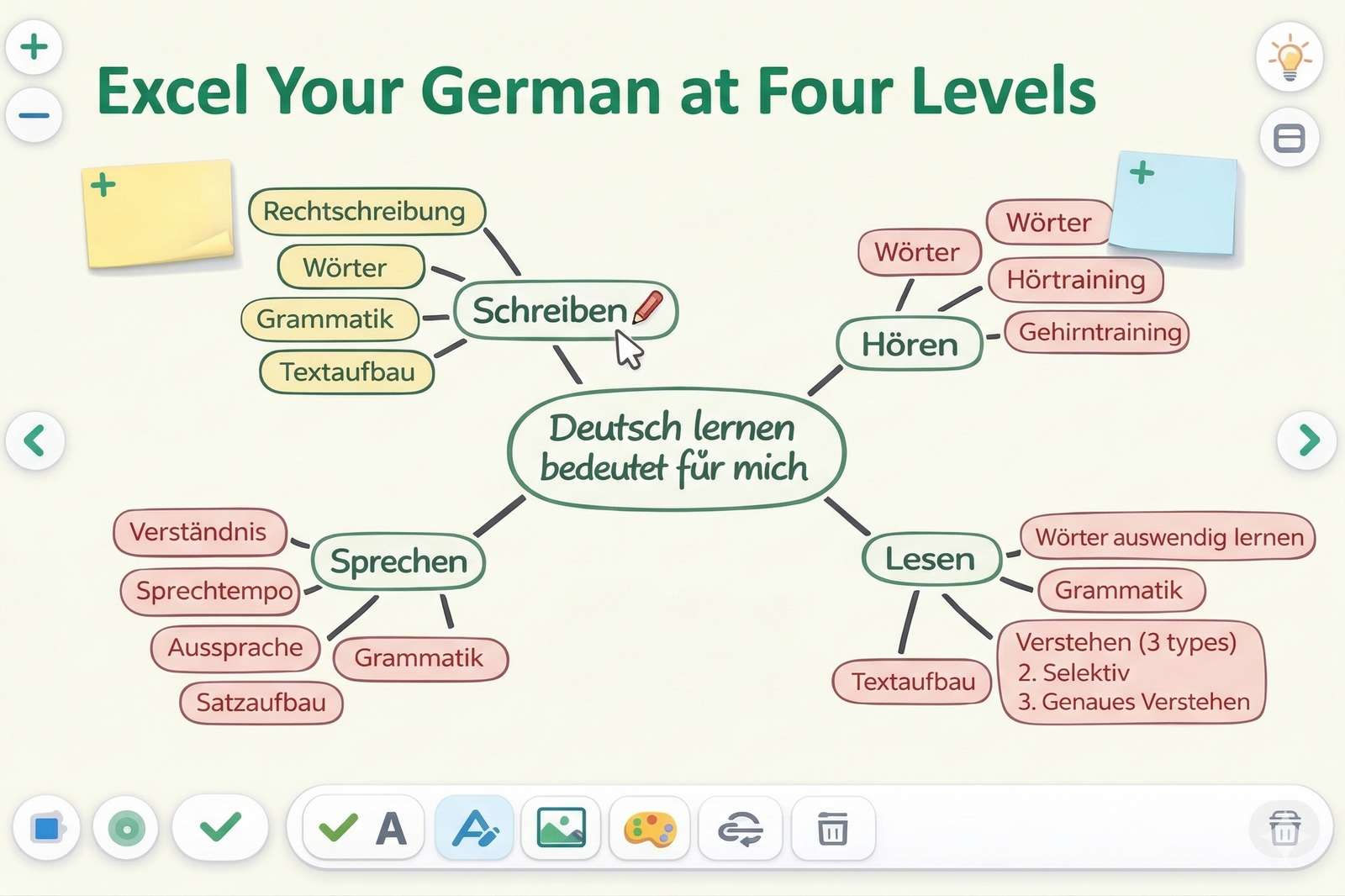
Have you ever felt like you’re “studying” a language for hours, but when it’s time to actually use it, the words just… vanish? You aren’t alone. Many learners get stuck because they focus on just one piece of the puzzle. To truly own a language, you don’t need a secret formula; you need a balanced ecosystem.
Think of your language journey as a house supported by four pillars. If one is weak, the whole structure shakes. Here is how to master the four essential tools to build a fluent future.
1. Reading: Your Vocabulary Engine
What it involves: Engaging with written text, from children’s books and news articles to social media posts. Why it’s important: Reading allows you to see grammar in “slow motion.” It helps you recognize sentence structures and builds a massive passive vocabulary that you’ll later use when speaking.
Pro Tip: Start with “Graded Readers” designed for your specific level (A1, B1, etc.) rather than jumping straight into complex novels. This keeps you motivated instead of frustrated!
2. Listening: The Rhythm of the Language
What it involves: Tuning your ears to the sounds, intonation, and speed of native speakers through podcasts, music, or movies. Why it’s important: This is how you develop an “ear” for the language. It helps you understand different accents and—most importantly—prevents you from sounding like a textbook.
Pro Tip: Try “Active Listening.” Listen to a short audio clip (1–2 minutes) and write down exactly what you hear. It forces your brain to catch those tiny filler words you usually miss.
3. Writing: The Precision Lab
What it involves: Putting thoughts onto paper (or screen), focusing on spelling, grammar, and text structure. Why it’s important: Writing gives you the gift of time. Unlike speaking, you can stop, think, and look up the perfect word. This reinforces what you’ve learned and builds “muscle memory” for correct grammar.
Pro Tip: Keep a simple daily journal. Write just three sentences about your day. It’s a low-pressure way to practice daily.
4. Speaking: The Ultimate Goal
What it involves: Producing sounds and communicating ideas in real-time, focusing on pronunciation and flow. Why it’s important: This is where the magic happens! Speaking transforms “knowledge” into “skill.” It builds the confidence needed to navigate the real world.
Pro Tip: Practice Shadowing. Listen to a native speaker and repeat exactly what they say at the same time they are saying it. This improves your tempo and accent instantly.
The Secret Sauce: Synergy
These four tools aren’t separate subjects; they are a complete system. Reading fuels your writing; listening improves your speaking. When you combine all four, you stop translating in your head and start thinking in the language.
Which of these four levels do you find the most challenging? Let me know, and I can suggest a specific exercise to help you conquer it!